
Custom URL Settings: how to deactivate plugins by URL
With the Custom URL Settings, you can disable specific plugins based on the page URL.

You can use the asterisk (*) as a wildcard to replace any group of characters.
Example:
http://localhost/freesoul_development*example/
will match URLs such as:
http://localhost/freesoul_development/an-example/http://localhost/freesoul_development/another-example/
You can also disable plugins based on URL query parameters.
Example:
*?example-parameter=true
will match URLs such as:
http://localhost/freesoul_development?example-parameter=truehttp://localhost/freesoul_development/page-example/?example-parameter=true
Behavior in the PRO version
In the PRO version, if you activate the filter (as shown in the image), the plugins that are unchecked in that row will be disabled whenever the URL matches the pattern.
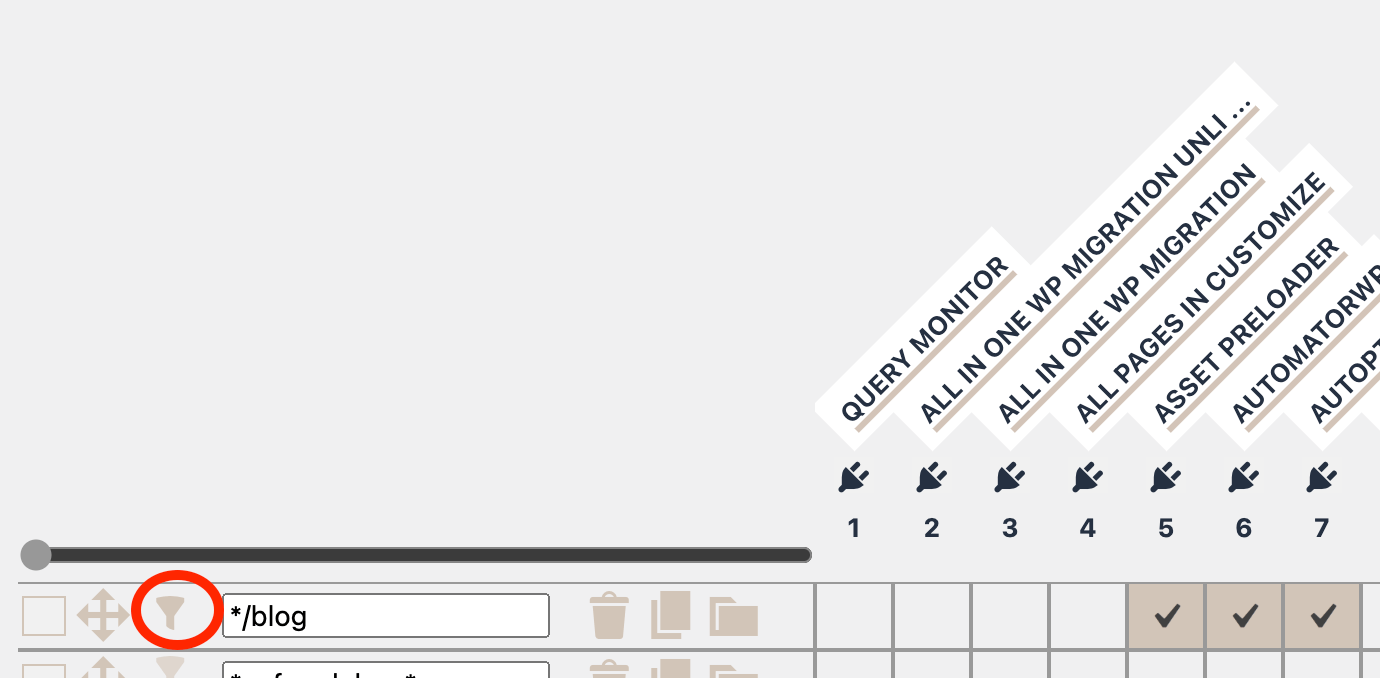
However, the active plugins will still be determined by all other FDP settings (such as Singles, Post Types, etc.).
Example:
As shown in the image, the plugins Query Monitor, All In One WP Migration, All In One WP Migration Unlimited Extension, and All Pages In Customize are disabled when the URL includes /blog — for example, https://yoursite.com/blog.
This means:
For any URL that contains
/blog, these plugins will never load.
You are not specifying which plugins should be loaded — only which ones should not load when the URL matches the pattern */blog.
If the filter is not activated, FDP will load only the plugins checked in that row, ignoring other settings like Singles or Post Types.
⚠️ Warning for Custom URL Settings
- Test carefully: Incorrect patterns can disable plugins on unintended pages.
- Check dependencies: Make sure required plugins for that URL remain active.
- Preview URLs: Always test pages with query parameters or dynamic URLs after changes.
✅ Custom URL setup checklist
- ☐ Identify URLs where plugins should be disabled
- ☐ Use wildcards (*) correctly to match multiple pages if needed
- ☐ Decide which plugins should remain active
- ☐ Preview each affected URL
- ☐ Use PRO filter mode if you want only unchecked plugins to be disabled
Real-world examples: Custom URLs
- Blog section: Disable heavy plugins like Query Monitor, migration plugins, or page builders for
/blog/*URLs. - Landing pages: Keep only essential plugins active for
/landing-page*URLs to speed up load times. - Checkout pages: Disable non-critical plugins for
/checkout*URLs to improve performance.
Tip: Use Custom URLs to override other FDP settings for specific pages, but always test carefully to avoid breaking functionality.