
Archives: how to deactivate plugins on specific archive pages
When an archive page is loaded, Freesoul Deactivate Plugins will disable plugins according to the Archives settings.
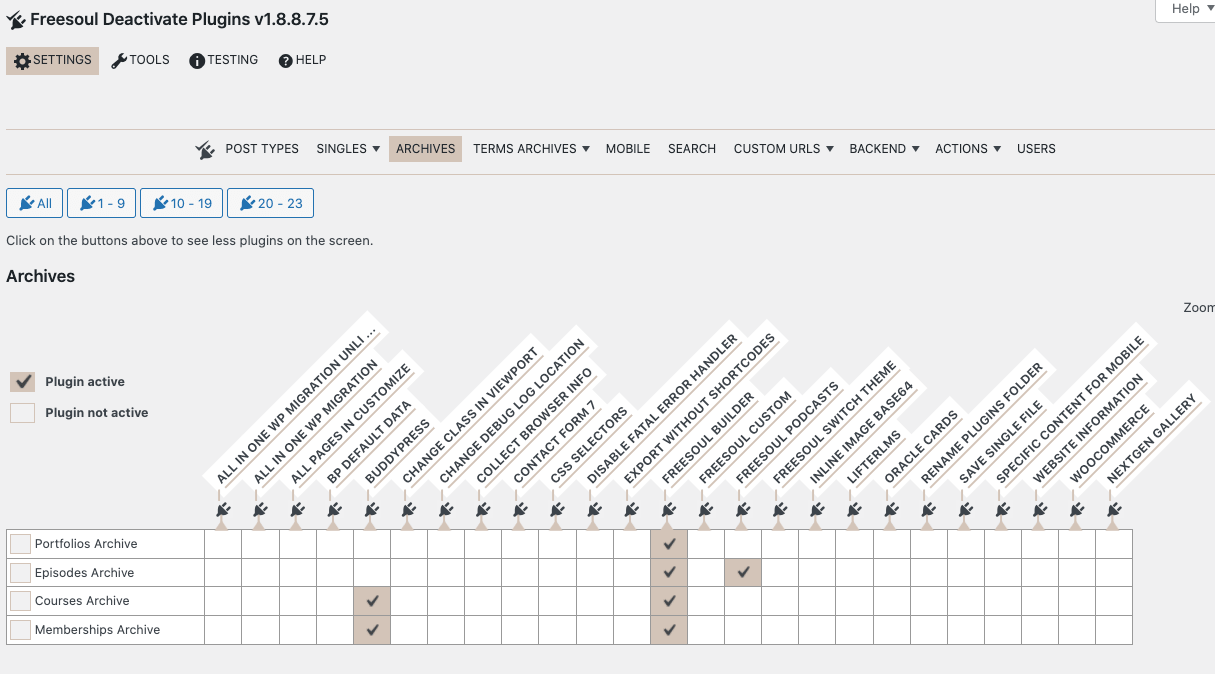
Here are some examples to clarify how it works:
- Portfolios archive: Only Freesoul Builder remains active; all other plugins are disabled.
- Episodes archive: Freesoul Builder and Freesoul Podcasts remain active; all other plugins are disabled.
- Course archives: If you keep only Freesoul Builder and BuddyPress, the page may break because the archive is generated by LifterLMS.
Important: Be careful when disabling plugins. Incorrect settings may break important functionality. Freesoul Deactivate Plugins is a tool: the results depend on how you use it.
PRO users benefit from auto-suggestions for unused plugins. In any case, you need to identify manually which plugins can be safely disabled.
⚠️ Warning for Archives settings
- Test before disabling: Always preview the archive pages after changes.
- Check dependencies: Some archives depend on specific plugins like LMS or WooCommerce.
- Start small: Disable only non-critical plugins first, then expand gradually.
✅ Archives setup checklist
- ☐ Identify which archive pages need plugin deactivation
- ☐ Determine which plugins are essential for each archive
- ☐ Disable only unnecessary plugins for each archive
- ☐ Preview each archive after making changes
- ☐ Use PRO auto-suggestions if available
- ☐ Document any exceptions to handle in Custom URLs
Real-world examples: Archives
- Portfolio archive: Keep the portfolio plugin and builder active; disable unrelated plugins like WooCommerce or LMS.
- Blog post archive: Keep SEO plugin,and builder, disable unrelated forms, LMS, or e-commerce plugins.
- Course archive (LMS): Keep the LMS plugin (LifterLMS or LearnDash) and builder,; disable other unrelated plugins carefully.
Tip: Start with minimal deactivation for archives and gradually expand as you verify functionality.